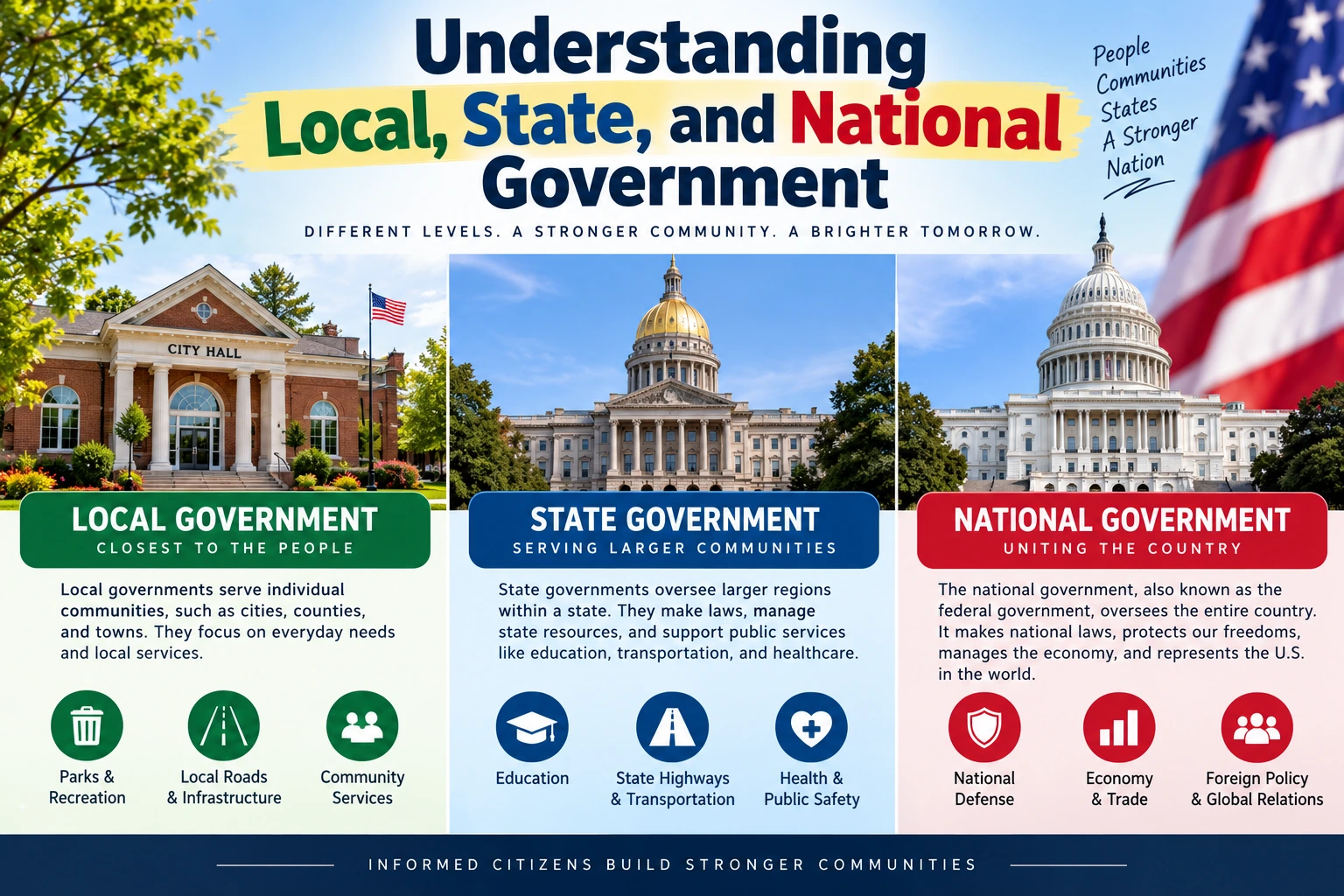
Government affects almost every part of daily life, from roads and public transportation to education, healthcare, national security, and economic policies. In many countries, government responsibilities are divided among different levels so that decisions can be made at the most appropriate level. Understanding the difference between local, state, and national government makes it easier to understand how public services work and who is responsible for particular decisions.
What Is Local Government?
Local government is the level closest to residents. It generally manages services and issues that directly affect communities, towns, cities, districts, or municipalities.
Common local responsibilities include maintaining local roads, managing waste collection, supporting public parks, overseeing certain building regulations, and providing community services. Depending on the country and local structure, local authorities may also have responsibilities related to water supply, sanitation, local transportation, libraries, and public spaces.
Because local governments operate close to residents, they can respond to community-specific needs. For example, a city government may decide where to improve a neighborhood road, develop a public park, or introduce local traffic measures.
What Is State or Regional Government?
State, provincial, or regional government operates at a level between local and national government. In countries with federal or decentralized systems, this level can have significant authority over public services and legislation.
State governments may oversee areas such as education, healthcare, transportation, policing, agriculture, infrastructure, and economic development, although responsibilities differ depending on the country’s constitution.
State governments can also coordinate activities between multiple local governments. A transportation project that connects several cities, for example, may require planning and funding at the state or regional level rather than being handled by one municipality.
What Is National Government?
National government, sometimes called the central or federal government, deals with issues affecting the country as a whole. Its responsibilities typically include national defense, foreign relations, currency, international trade, immigration, and national economic policy.
National governments also create laws and policies that apply across the country. They may establish national standards for areas such as taxation, environmental protection, public safety, and economic regulation.
In federal countries, national authority is shared with state or regional governments. In more centralized systems, the national government may have greater control over policy and public administration.
How the Three Levels Work Together
The different levels of government are not completely separate. They often need to cooperate to deliver services and implement policies.
Consider a major infrastructure project. A local authority might identify a community transportation need, a state government could coordinate the broader project, and the national government might provide funding or establish regulatory standards.
Healthcare provides another example. National authorities may establish broad policies or funding programs, state governments may administer healthcare systems, and local authorities may support community-level services.
Effective cooperation can help avoid duplication and ensure public resources are used efficiently.
Why Government Responsibilities Are Divided
Dividing responsibilities allows decisions to be made closer to the people affected by them while keeping nationwide issues coordinated.
Local authorities understand community needs better because they operate directly within neighborhoods. State governments can address regional concerns that cross municipal boundaries. National governments can focus on matters requiring a unified approach across the country.
This structure can also create checks and balances. Different levels may have different responsibilities and sources of authority, helping prevent too much power from being concentrated in one place.
How Citizens Interact With Government
Citizens interact with all three levels of government in different ways. Local elections may determine city or municipal leadership, while state or regional elections select representatives responsible for broader policies. National elections determine national leadership and representation.
People can also participate by attending public meetings, contacting elected representatives, submitting feedback, voting, joining community initiatives, and learning about proposed policies.
Understanding which government level handles a particular issue can make it easier to raise concerns and find the appropriate authority.
Why Civic Knowledge Matters
Knowing how government works helps people become more informed citizens. When residents understand responsibilities at each level, they can better evaluate public policies and hold elected officials accountable.
It also helps prevent confusion. A local road problem may need to be addressed by a municipal authority, while a national immigration policy would generally fall under the national government.
Civic knowledge encourages people to participate constructively in their communities and understand how public decisions affect everyday life.
Conclusion
Local, state, and national governments each play important roles in managing society. Local government focuses on community-level needs, state or regional government handles broader areas within a region, and national government addresses matters affecting the entire country.
The exact division of responsibilities varies between nations, but cooperation among government levels remains important. By understanding how these institutions function and how citizens can engage with them, people can make more informed decisions, communicate their concerns effectively, and participate more meaningfully in civic life.